



Traditional assortment planning relies on gut feeling and sales correlations – but that doesn’t scale. Semantic analysis uses AI and NLP to automatically detect which products compete (substitutes) and which drive incremental sales (complements). The result? Smarter SKU decisions, reduced cannibalization, and up to 15% higher basket size. Here’s how it works.
Every retail and FMCG category manager knows the feeling: you’re staring at hundreds of SKUs, trying to figure out which products cannibalize each other and which ones drive incremental sales. Traditional approaches rely on gut feeling, historical sales correlations, or manual category reviews. But correlation doesn’t always reveal causation, and manual analysis doesn’t scale.
This is where semantic analysis comes in. By applying AI and natural language processing (NLP) to product attributes, descriptions, and customer behavior data, you can automatically detect substitutes (products that replace each other) and complements (products that are bought together). The result? Smarter assortment decisions, reduced cannibalization, and increased basket size.
What is semantic analysis in assortment optimization?
Semantic analysis uses machine learning and NLP to understand the meaning and relationships between products—not just their sales patterns. Instead of relying solely on transaction data, it analyzes:
- Product descriptions (ingredients, features, use cases)
- Category attributes (flavor, size, packaging, brand positioning)
- Customer search and browsing behavior
- Basket composition (what’s purchased together)
By combining these signals, semantic models can identify:
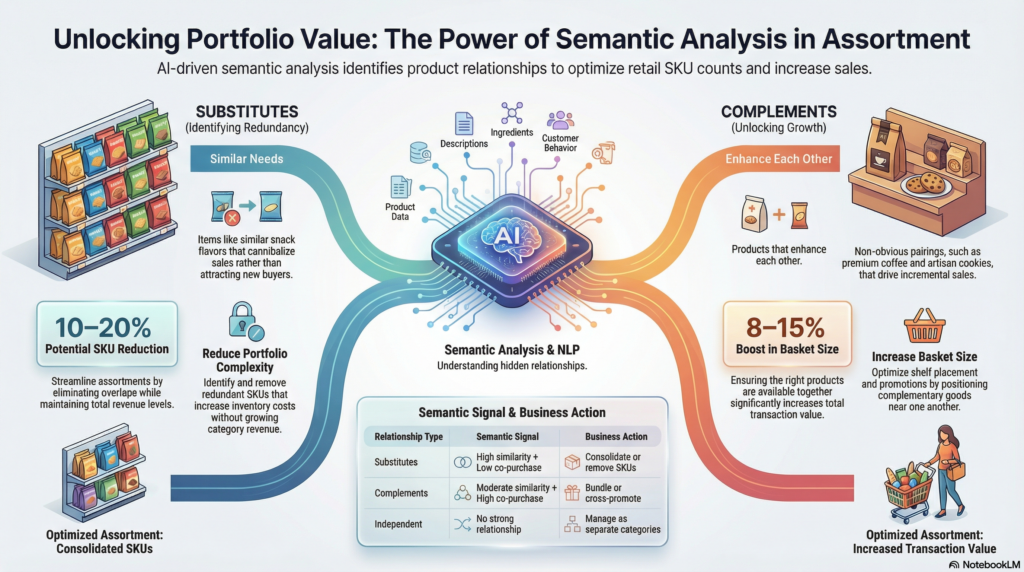
- Substitutes: Products that serve the same need (e.g., two similar snack flavors, competing brands in the same price tier)
- Complements: Products that enhance each other (e.g., chips + dip, coffee + cookies, shampoo + conditioner)
This goes beyond simple ‘frequently bought together’ logic. Semantic analysis understands why products are related, which enables more strategic assortment planning
.
Why detecting substitutes matters
Substitutes compete for the same customer need. If you stock too many similar SKUs, you are not growing the category you are just splitting sales across more products. This leads to:
- Cannibalization: New SKUs steal share from existing ones instead of attracting new buyers
- Operational complexity: More SKUs mean higher inventory costs, more shelf space pressure, and increased risk of stockouts or overstocks
- Diluted brand equity: Too many similar options confuse customers and weaken brand positioning
What semantic analysis enables:
- Identify redundant SKUs: Find products that are too similar in function, flavor, or positioning
- Optimize portfolio size: Keep the right number of SKUs that maximize category revenue without unnecessary overlap
- Plan new product introductions: Predict which existing SKUs will be cannibalized before launch
- Improve space allocation: Prioritize SKUs that drive incremental value, not just volume
Example: A snack brand discovers through semantic analysis that three of its “cheese-flavored” SKUs are nearly identical in customer perception. By consolidating to two SKUs and reallocating shelf space to a complementary product (e.g., a dip), they reduce complexity and increase basket size by 8%.
Why detecting complements drives growth
Complements unlock incremental sales. When you understand which products are naturally purchased together, you can:
- Design better assortments: Ensure complementary products are available in the same store clusters
- Optimize shelf placement: Position complements near each other to encourage basket building
- Create smarter promotions: Bundle or cross-promote products that drive incremental purchases
- Increase basket size: Customers buy more when the right products are available together
What semantic analysis enables:
- Discover non-obvious complements: Go beyond “chips + salsa” to find hidden relationships (e.g., a specific coffee flavor pairs well with a particular cookie type)
- Personalize assortments by cluster: Different store types or regions may have different complement patterns
- Predict cross-category opportunities: Identify complements across categories (e.g., beverages + snacks, personal care + cosmetics)
Example: A retailer uses semantic analysis to discover that customers who buy premium coffee are 3x more likely to purchase artisan cookies—but only if both are available in the same store. By ensuring this pairing in high-value clusters, they increase basket size by 12% in those locations.
How semantic analysis works in practice
Here is a simplified workflow:
1) Data collection
Gather product attributes (descriptions, ingredients, packaging), transaction data (baskets, purchase frequency), and customer signals (search queries, browsing behavior).
2) Semantic modeling
Apply NLP techniques (e.g., word embeddings, transformer models) to encode product attributes into a semantic space where similar products are close together and complements are identified through co-occurrence patterns.
3) Relationship detection
Use machine learning to classify product pairs as:
- Substitutes (high semantic similarity + low co-purchase rate)
- Complements (moderate semantic similarity + high co-purchase rate)
- Independent (no strong relationship)
4) Business rules and validation
Combine AI insights with category expertise to validate findings and translate them into actionable assortment decisions.
5) Continuous optimization
Monitor performance (sales lift, basket size, margin) and refine models as customer preferences and market conditions evolve.
Real-world impact: what you can measure
When you apply semantic analysis to assortment optimization, you can expect:
- Reduced SKU count (by 10–20%) without losing revenue—by eliminating redundant substitutes
- Increased basket size (by 8–15%)—by ensuring complements are available and well-positioned
- Higher category ROI—by focusing inventory and shelf space on high-value SKUs
- Faster time-to-market—by predicting cannibalization and complement effects before launching new products
- Better localized assortments—by tailoring substitute/complement strategies to store clusters
Common pitfalls (and how to avoid them)
Pitfall #1: Relying only on transaction data
Sales correlations can be misleading. Two products may sell together because they are both popular, not because they are true complements.
Solution: Combine transaction data with semantic attributes and customer behavior signals.
Pitfall #2: Ignoring category context
A substitute in one category may behave differently in another (e.g., premium vs. value tiers).
Solution: Build category-specific models and validate with domain expertise.
Pitfall #3: Treating semantic analysis as a one-time project
Customer preferences and market dynamics change. Static models lose accuracy over time.
Solution: Implement continuous learning pipelines and regular model retraining.
Getting started: what you need
To implement semantic analysis for assortment optimization, you will need:
- Clean, structured product data: Descriptions, attributes, category hierarchies
- Transaction data: Basket-level purchase history
- AI/ML infrastructure: NLP models, feature engineering pipelines, optimization algorithms
- Category expertise: To validate findings and translate insights into business actions
- Interactive dashboards: To monitor performance and enable ongoing refinement
If you are starting from scratch, focus on one high-value category (e.g., snacks, beverages, personal care) and prove the concept before scaling.
The bottom line
Semantic analysis transforms assortment optimization from a manual, gut-driven process into a data-backed, scalable system. By automatically detecting substitutes and complements, you can:
- Reduce portfolio complexity without sacrificing revenue
- Unlock hidden growth by ensuring the right products are available together
- Increase basket size through smarter assortment and placement decisions
- Respond faster to market changes and new product launches
Read more: How to Find the Best Mattress Deals Without Falling for Gimmicks
